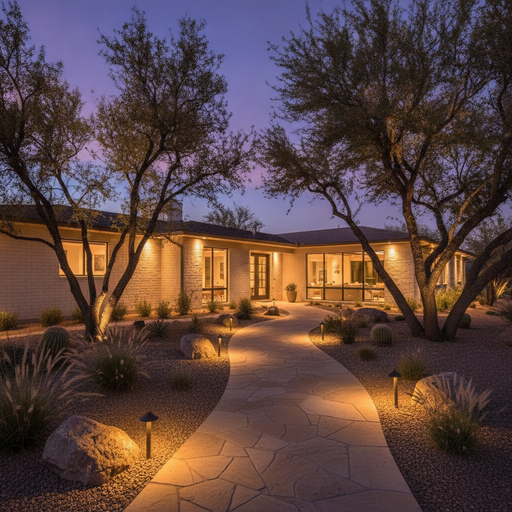

The Magic of the Golden Hour and Beyond
Imagine pulling into your driveway after a long day at work. The sun has dipped below the horizon, leaving the world in a hazy, blue twilight. For many, this is when their home disappears into the shadows, becoming nothing more than a dark silhouette against the night sky. But for a ranch home designed with thoughtful landscape lighting, this is the moment the magic begins.
SUBMIT YOUR DETAILS FOR
Ranch-style homes, with their iconic long, low profiles and sprawling footprints, offer a unique canvas for light. Unlike multi-story houses that reach for the clouds, the ranch home embraces the earth. It is horizontal, grounded, and often features wide eaves and large windows that blur the line between indoors and out. To light a ranch home effectively, we have to respect these architectural lines while enhancing the safety and beauty of the surrounding landscape. In this guide, we are going to walk through how to transform your single-story sanctuary into a nighttime masterpiece through the art of landscape lighting.
Understanding the Ranch Silhouette
Before we dive into the specific fixtures and bulbs, let’s talk about the “why.” The goal of lighting a ranch home isn’t just to make it bright; it’s to create depth and drama. Because ranch homes are low to the ground, they can easily look “flat” at night if you only use a single porch light. By layering your lighting, you create a three-dimensional experience that guides the eye from the curb all the way to the front door.
The beauty of the ranch layout is its continuity. Whether you have a classic mid-century modern ranch or a rustic California ranch, the architectural interest lies in the textures of the siding, the shape of the roofline, and the integration of the garden. Our mission is to highlight these features without making the house look like a landing strip at an airport.
The Art of Path Lighting: Safety Meets Style
The first place most homeowners start is the walkway. It’s practical—you need to see where you’re walking—but it’s also your guests’ first introduction to your home. For a ranch home, which often features long, winding paths, the key is “subtlety.”
Avoid the “soldier effect,” where lights are placed in a perfectly straight line directly opposite each other. This can feel rigid and clinical. Instead, stagger your lights. Place one on the left, then a few feet further down on the right. This creates a soft, rhythmic flow that mimics a natural trail. Use “hatted” fixtures that direct light downward. This prevents glare and ensures that the light illuminates the ground where it’s needed, rather than shining into your eyes as you walk.
Pro Tip: Choose the Right Scale
Since ranch homes are low, oversized path lights can look out of place. Opt for fixtures that are proportional to your plants and the height of your home’s foundation. You want the light to be the star, not the metal pole holding it up.
Wall Washing and Grazing: Accentuating Texture
One of the most effective techniques for a ranch home is “wall washing.” Because these homes have long stretches of exterior walls, they are perfect candidates for a soft, even glow. By placing wide-angle floodlights a few feet away from the house and aiming them upward, you create a “wash” of light that highlights the color and material of your home.
If your ranch home features beautiful stone masonry, reclaimed wood, or textured brick, you might want to try “grazing.” This involves placing the light fixture much closer to the wall—almost touching it—and aiming the beam straight up. This creates high-contrast shadows that make the texture of the material pop, adding a sense of luxury and architectural intent that is often lost in the dark.
Highlighting the Vertical in a Horizontal World
To balance the horizontal nature of a ranch home, you need to find vertical elements in your landscape to highlight. This is where “uplighting” comes into play. Do you have a majestic oak tree in the front yard? A cluster of tall ornamental grasses? Or perhaps a set of architectural columns supporting your entryway porch?
By placing well-lights or bullet lights at the base of these features and pointing them upward, you create “anchors” for the eye. This breaks up the long horizontal lines of the house and adds a sense of height to the property. When lighting trees, try to place the light inside the canopy to illuminate the branches from within, creating a glowing, ethereal effect that looks much more natural than simply shining a light at the trunk.
The Importance of Shadows
In landscape lighting, what you don’t light is just as important as what you do. This is the concept of “chiaroscuro”—the play between light and dark. You don’t want your yard to be a wash of white light. You want pockets of darkness to provide contrast. This creates a sense of mystery and allows the highlighted areas to truly shine. For ranch homes, using shadows to define the different “wings” of the house can help emphasize its sprawling, comfortable nature.
Smart Lighting and Energy Efficiency
We live in an age where your phone can control your entire home, and your landscape lighting should be no different. For a ranch home, which may have lighting needs that change from the front yard to the backyard patio, a smart transformer is a game-changer.
- Zoning: You can set your front path lights to turn on at dusk and off at midnight, while keeping your backyard security lights on a motion sensor.
- Dimming: Maybe you want full brightness when you’re hosting a summer barbecue, but a soft, romantic glow for a quiet Tuesday night. Smart LEDs allow you to adjust the intensity with a swipe.
- Color Temperature: Stick to “warm white” (around 2700K to 3000K). This mimics the cozy glow of an indoor lamp and makes the home feel inviting. Avoid “cool blue” lights, which can make a home look like a commercial parking lot.
Common Mistakes to Avoid
Even with the best intentions, it’s easy to go overboard. Here are a few things to keep in mind as you plan your ranch home design:
- Over-lighting: Your home shouldn’t be visible from space. Less is almost always more. Focus on key features rather than trying to illuminate every square inch.
- Light Pollution: Be a good neighbor. Ensure your lights are aimed at your house or your landscape, not into the windows of the house across the street.
- Neglecting Maintenance: Landscape lights live outside. They get covered in mulch, bumped by lawnmowers, and obscured by growing shrubs. Make it a habit to trim back foliage and clean your lenses once a season.
The Backyard Retreat
While curb appeal is important, don’t forget the areas where you actually spend your time. Many ranch homes feature “U-shaped” or “L-shaped” layouts that create a private courtyard or large back patio. Use “moonlighting” here—placing lights high up in trees and aiming them down through the branches—to create a soft, dappled light that mimics a full moon. This provides enough light to see your guests’ faces without the harshness of a traditional patio light.
Conclusion: Bringing it All Together
Designing the landscape lighting for a ranch home is about more than just sticking lamps in the ground. It’s about storytelling. It’s about choosing which parts of your home’s personality you want to reveal when the sun goes down. By focusing on the horizontal lines, embracing the textures of your walls, and using trees to add vertical interest, you can turn a simple single-story house into an elegant, inviting estate.
The best part? You don’t have to do it all at once. Start with the path to your front door, then add a few uplights to your favorite trees. Slowly but surely, you’ll see your home transform. And the next time you pull into that driveway at twilight, you won’t just see a dark silhouette—you’ll see a warm, glowing welcome that truly feels like home.