
The First Impression: Why Your Home’s Exterior Tells a Story
Imagine pulling into your driveway after a long day at work. You turn off the engine, step out of the car, and look up. What do you see? For many homeowners, the answer is a house that feels “fine,” but doesn’t necessarily spark joy. Maybe the siding has faded under years of relentless sun, or perhaps the windows look like they belong in a different decade. Your home is more than just a shelter; it is a reflection of your journey, your tastes, and your pride of ownership.
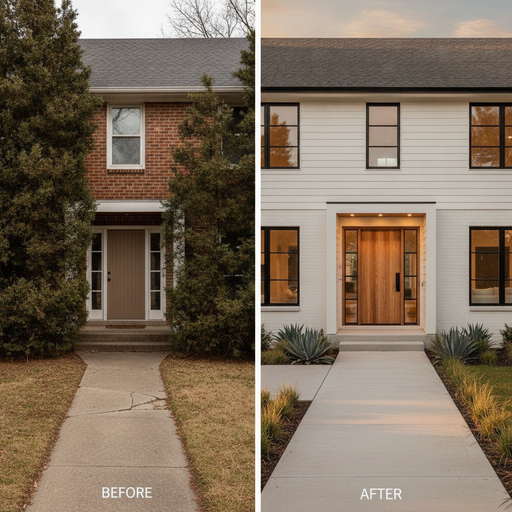
A custom home exterior renovation isn’t just about “fixing” things; it’s about transformation. It’s the architectural equivalent of a butterfly emerging from its cocoon. In this guide, we’re going to walk through the narrative of a total home makeover, from the initial spark of inspiration to the moment you stand on the sidewalk and realize your house is finally the one everyone stops to admire.
SUBMIT YOUR DETAILS FOR
Step 1: The Vision Board and the “Why”
Every great renovation starts with a dream. Before you pick up a hammer or call a contractor, you need to define your “why.” Are you looking to increase your property value for a future sale, or are you creating your “forever home” that reflects your unique personality? Understanding your motivation will guide every decision you make.
Start by gathering inspiration. Walk through your favorite neighborhoods or browse digital platforms. Look for patterns. Do you gravitate toward the clean, sharp lines of Modern Industrial design? Or do you find comfort in the warmth of a Modern Farmhouse with its white siding and black accents? Creating a vision board—whether physical or digital—allows you to see how different textures and colors play together before you commit a single dollar to materials.
Step 2: The Shell – Choosing Your Siding and Cladding
If the walls of your home are its skeleton, then the siding is its skin. It is the most visible element of your home’s exterior and plays a massive role in both aesthetics and protection. In the world of custom renovations, you aren’t limited to the standard vinyl of the past.
Fiber Cement Siding
Often referred to by the brand name James Hardie, fiber cement is the gold standard for many custom projects. It mimics the look of real wood but is resistant to fire, termites, and rot. It’s the perfect choice for homeowners who want the “Cape Cod” look without the high maintenance of cedar shingles.
Natural Stone and Brick Veneer
Adding stone or brick to your exterior adds a sense of permanence and luxury. You don’t have to cover the whole house; using stone as an accent on the lower third of the home or on a prominent entryway can create a “grounded” look that feels sophisticated and timeless.
Wood Accents
To bring warmth to a modern design, many homeowners are turning to natural wood accents. Cedar or Ipe wood slats used on a porch ceiling or as a vertical feature wall can break up the monotony of modern materials, providing a soft, organic touch that invites people in.
Step 3: The Eyes of the Home – Windows and Doors
Windows are often called the “eyes” of the home, and for good reason. They dictate how you see the world from the inside and how the world perceives the character of your home from the outside. A custom renovation often involves “upsizing” windows—turning small, cramped openings into floor-to-ceiling glass that blurs the line between indoors and outdoors.
When selecting windows, consider the “grille” pattern. Thin, black steel-look frames are currently trending for their ability to provide a “Modern Tudor” or “Industrial” vibe. Beyond looks, modern windows offer incredible energy efficiency. Low-E coatings and argon gas fills mean your home stays cool in the summer and warm in the winter, making this an investment that pays for itself over time.
Then, there is the front door. This is your home’s handshake. A custom-built pivot door or a massive arched wooden entry can act as the centerpiece of your entire renovation. Don’t be afraid to go bold with color here—a deep navy, a forest green, or even a vibrant mustard can provide that “pop” that makes your home memorable.
Step 4: The Crown – Roofing and Gutters
The roof is often the most overlooked part of an exterior renovation until it starts leaking. However, from a design perspective, the roof is the “crown” of your home. It ties everything together. If you’re going for a modern look, consider a standing-seam metal roof. Not only do they last 50+ years, but they also provide a sleek, architectural finish that asphalt shingles simply can’t match.
If your budget leans toward traditional, architectural shingles can provide depth and shadow lines that mimic slate. Speaking of slate, if you have a historic home, nothing beats the real thing—though modern composite slate offers a similar look at a fraction of the weight and cost. Don’t forget the gutters! Switching from standard white aluminum to copper or “euro-style” half-round black gutters can take a house from “standard” to “custom” instantly.
Step 5: Layering the Light – Exterior Illumination
A custom renovation shouldn’t disappear when the sun goes down. In fact, some of the most beautiful homes look even better at night thanks to professional lighting design. The key is “layering.”
- Uplighting: Place lights at the base of your home or under beautiful trees to cast dramatic shadows and highlight textures.
- Path Lighting: Guide guests to your door with soft, low-level lights that ensure safety without looking like a runway.
- Wall Sconces: Choose fixtures that match your home’s architectural style. Large, oversized lanterns can frame a front door beautifully.
Step 6: The Finishing Touch – Landscaping and Hardscaping
You could have the most beautiful custom exterior in the world, but if it’s surrounded by a patch of dead grass, the effect is lost. Think of landscaping as the frame for your masterpiece. Hardscaping—the use of stone paths, retaining walls, and built-in planters—provides structure to your yard.
Consider a “living” driveway using permeable pavers that allow grass to grow through, or a modern concrete walkway with clean, geometric lines. Plantings should be layered by height and color, ensuring that there is visual interest during every season of the year. Evergreens provide the “bones” for winter, while pereials offer the “jewelry” of spring and summer flowers.
The Practical Side: Logistics and Budgeting
While the creative side is exciting, a custom renovation requires a steady hand on the logistics. First, check your local zoning laws and HOA (Homeowners Association) guidelines. There is nothing worse than falling in love with a bold charcoal siding only to find out your neighborhood requires “earth tones.”
Second, choose your team wisely. A custom exterior renovation often requires a general contractor who understands the interplay between different materials. You want someone who treats the flashing around your windows as seriously as the color of your paint. Quality craftsmanship is the difference between a renovation that looks good for two years and one that looks good for twenty.
Conclusion: Coming Home
The journey of a custom home exterior renovation is an investment in your quality of life. It’s a complex puzzle of colors, textures, and structural integrity, but the result is something truly magical. When the scaffolding finally comes down and the last shrub is planted, you aren’t just looking at a house anymore. You are looking at a statement—a sanctuary that reflects exactly who you are.
So, take that first step. Start that vision board. Your home has a story to tell, and a custom renovation is the best way to make sure it’s a bestseller. Every time you drive up to your house, you should feel a swell of pride. After all, you didn’t just fix a house; you created a home.