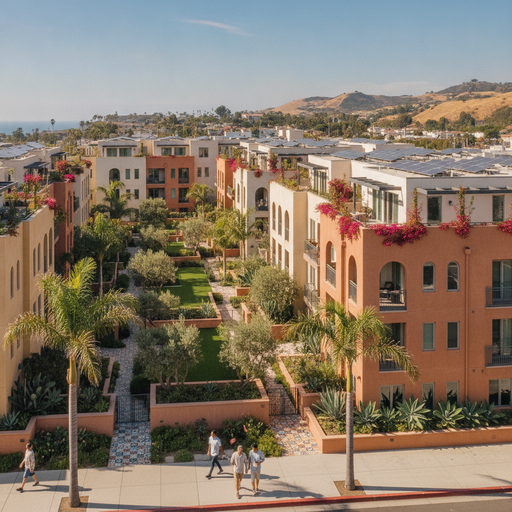

For decades, the “California Dream” was synonymous with a sprawling suburban home, a two-car garage, and a sun-drenched backyard. From the tech hubs of Silicon Valley to the glamorous hills of Los Angeles, people flocked to the Golden State with visions of prosperity. However, for many modern Californians, that dream has hit a significant roadblock: a chronic and historic shortage of housing supply. If you have tried to buy a home or even find a reasonably priced apartment in California lately, you know the story all too well. It is a tale of fierce competition, sky-high prices, and a “sold” sign that appears before you can even finish a walkthrough.
SUBMIT YOUR DETAILS FOR
But the story is starting to shift. As we move through 2024, the landscape of California housing is undergoing a radical transformation. Driven by bold new laws, a surge in backyard developments, and a changing economic climate, the supply trends in the nation’s most populous state are finally showing signs of a slow, albeit complex, evolution. Let’s dive into the story of where California’s housing stands today and where it is headed tomorrow.
The Historical Bottleneck: Why the Supply Dried Up
To understand where we are going, we have to look at how we got here. For nearly half a century, California failed to build enough housing to keep up with its booming population and economic growth. This wasn’t an accident; it was the result of a “perfect storm” of factors. Strict zoning laws favored single-family homes over apartments, while local “NIMBY” (Not In My Backyard) sentiment often blocked new developments before they could even break ground.
Furthermore, the California Environmental Quality Act (CEQA), while intended to protect the state’s beautiful natural resources, often became a tool for project opponents to delay construction for years through litigation. Combined with geographic constraints—mountains on one side and the ocean on the other—California found itself in a supply cage. By 2023, the state ranked near the bottom of the country in housing units per capita, leading to some of the highest living costs in the developed world.
The Rise of the ADU: A Backyard Revolution
If you walk through a quiet neighborhood in San Diego or San Jose today, you might notice something different. Small, stylish cottages are popping up in backyards where swing sets used to stand. These are Accessory Dwelling Units (ADUs), or “gray flats,” and they have become the unsung heroes of California’s housing supply. Over the last few years, the state legislature passed several laws that effectively ended single-family-only zoning, making it much easier for homeowners to build these small units.
The trend is staggering. In some cities, ADUs now account for nearly 20% to 30% of all new housing permits. They provide a vital “middle ground” of housing—perfect for elderly parents, adult children, or as a rental unit to help the homeowner pay a hefty mortgage. This “gentle density” is changing the face of California suburbs without the need for massive high-rise developments, proving that sometimes, the solution to a big problem can be found in small spaces.
State Intervention: The End of Local Gridlock
One of the most dramatic turns in the California housing story is the shift in power from local city halls to the state capitol in Sacramento. For years, local governments could easily say “no” to housing projects. Today, the state is increasingly saying “you must.”
The Builder’s Remedy
Perhaps the most talked-about trend in 2024 is the “Builder’s Remedy.” This is a legal provision that kicks in when a city fails to have a state-approved housing plan. In these cities, developers can bypass local zoning rules and build projects of almost any size, provided they include a certain percentage of affordable units. We are seeing massive projects proposed in wealthy enclaves like Santa Monica and Beverly Hills—places that haven’t seen significant new apartment construction in decades. This trend is signaling to developers that the “closed for business” sign in California is finally being taken down.
SB 9 and the Duplex Era
Senate Bill 9 (SB 9) is another major player. It allows homeowners to split their lots and build up to four units on what was once a single-family parcel. While the adoption of SB 9 has been slower than that of ADUs due to financing challenges, it represents a fundamental shift in land use. The era of the “exclusive” single-family neighborhood is slowly giving way to more inclusive, multi-generational communities.
The Economic Reality: Interest Rates and Construction Costs
While the laws are changing for the better, the economy is throwing a wrench in the gears. Even as the state clears the path for more homes, builders are facing a “triple threat”: high interest rates, labor shortages, and skyrocketing material costs. When it costs more to borrow money and more to buy lumber and steel, developers often press the “pause” button oew projects.
This has created a strange paradox in the 2024 market. We have more legal permission to build than ever before, but the actual number of “starts” (new construction projects begiing) has struggled to keep pace with the massive demand. For the average Californian, this means that while the supply pipeline is opening, it will take several more years before we see a significant cooling of prices.
The Great Migration: Inland and Central Valley Growth
As coastal cities like San Francisco and Los Angeles remain prohibitively expensive, the housing supply story is moving inland. We are seeing a “Great Migration” toward the Inland Empire, the Central Valley, and even the Sierra foothills. Cities like Riverside, Stockton, and Fresno are seeing a surge iew housing developments. This shift is being fueled by the persistence of remote and hybrid work, allowing professionals to trade a 15-minute coastal commute for a larger, more affordable home further east.
However, this trend brings its own set of challenges. Developing in these areas often requires long commutes and puts pressure on infrastructure and water resources. The trend in 2024 is to create “complete communities” in these inland areas—places where people can live, work, and play without having to drive two hours back to the coast.
The Future: Is the Tide Finally Turning?
The road to fixing California’s housing supply is a marathon, not a sprint. We are undoing decades of restrictive policy in a matter of years. The trends we see in 2024—the explosion of ADUs, the state’s aggressive “Pro-Housing” stance, and the focus on transit-oriented development—are all pieces of a larger puzzle.
What does this mean for you? If you are a buyer, it means more diverse options might be on the horizon, though patience is required. If you are a homeowner, your property might have more development potential than you ever imagined. And if you are an advocate for affordable housing, the momentum is finally on your side.
California is at a crossroads. It is choosing between remaining an exclusive enclave for the wealthy or returning to its roots as a land of opportunity for all. By embracing density, iovation, and a “yes in my backyard” attitude, the state is slowly but surely building a future where the California Dream is once again within reach.
Conclusion
The story of California’s housing supply is one of resilience and reform. While the challenges of high costs and interest rates remain formidable, the structural changes happening right now are unprecedented. From the backyard ADU to the large-scale projects fueled by the Builder’s Remedy, California is proving that it is ready to grow again. The dream isn’t dead; it’s just being rebuilt, one unit at a time.